
GRIT 5v5 Playing Rules
League Rules & Adoptions • Effective Fall 2026
RULES FRAMEWORK GRIT uses a national standardized 5v5 rules framework with league-specific adoptions. When a GRIT league adoption differs from the underlying framework, the GRIT adoption governs.
SCOPE These rules govern GRIT regular-season play unless GRIT announces a specific tournament or event modification. The GRIT Code of Conduct applies to players, coaches, team representatives, parents/guardians, and spectators.
Quick reference
| Rule | GRIT Standard |
|---|---|
| Players | 5 vs. 5 |
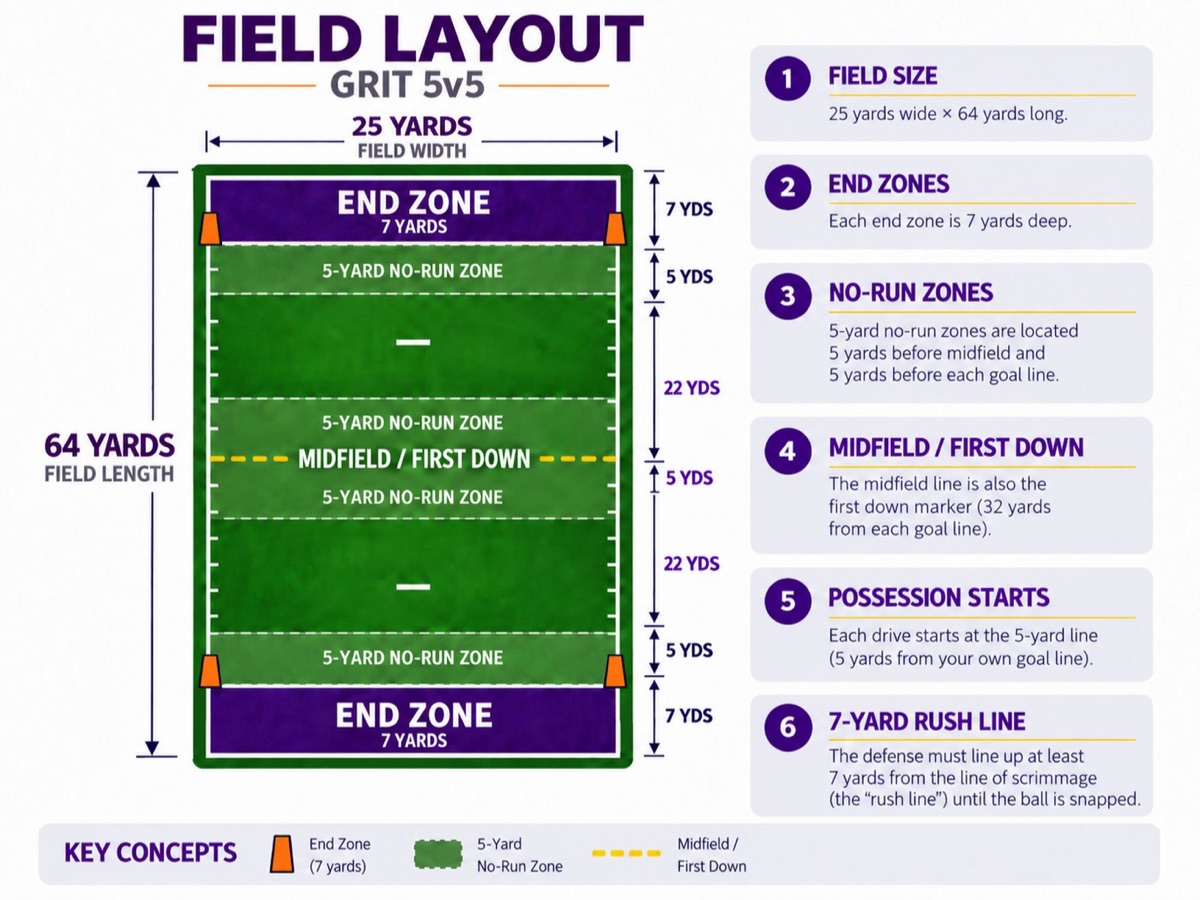
| Field | 25 yd wide × 64 yd long |
| End zones | 7 yd |
| Start | Own 5-yard line |
| First down | Cross midfield in 4 downs |
| After midfield | 3 downs to score |
| Game clock | 2 × 20-minute running halves |
| Play clock | 40 seconds |
| QB pass clock | 7 seconds |
| Rush | 1 rusher from 7 yards; youngest divisions excepted |
| Flags | 2 flags; 3 in youngest divisions |
| Timeouts | 1 × 60 sec per half |
| Mercy rule | 35 points |
| Regular-season OT | Maximum 2 rounds; then tie |
1. Game setup & possession
- A coin toss determines the opening choice. The visiting team calls the toss.
- The winner chooses offense or defense; the other team chooses direction. There is no deferral.
- Teams switch directions for the second half. The team that began the game on offense begins the second half on defense.
- The offense begins each new standard possession at its own 5-yard line.
- The offense has 4 downs to cross midfield. Once midfield is crossed, the offense has 3 downs to score.
Fourth down before midfield
- After third down, the offense may declare “Punt” or “Play.”
- Punt: possession changes, and the opponent starts at its own 5-yard line.
- Play: if the offense fails to cross midfield on fourth down, the opponent takes possession at the spot where the play ended.
- After midfield, failure to score by the end of third down results in a change of possession, with the opponent starting at its own 5-yard line.
2. Field
- Standard GRIT field: 25 yards wide × 64 yards long, including two 7-yard end zones.
- Midfield is the line-to-gain for the offense’s first down.
- No-run zones are the 5 yards immediately before midfield and the 5 yards immediately before the opponent’s goal line. On a full field, this creates a no-run zone on each side of midfield and one before each end zone.
- In a no-run zone, the ball must be advanced across the line of scrimmage by a forward pass.
- Stepping on a boundary line is out of bounds.
- The ball is normally spotted near the middle of the field and may not be spotted closer than 10 yards from a sideline.
YOUNGEST-DIVISION EXCEPTION for Girls K–2nd and Boys K–1st. No-run zones are eliminated
3. Equipment
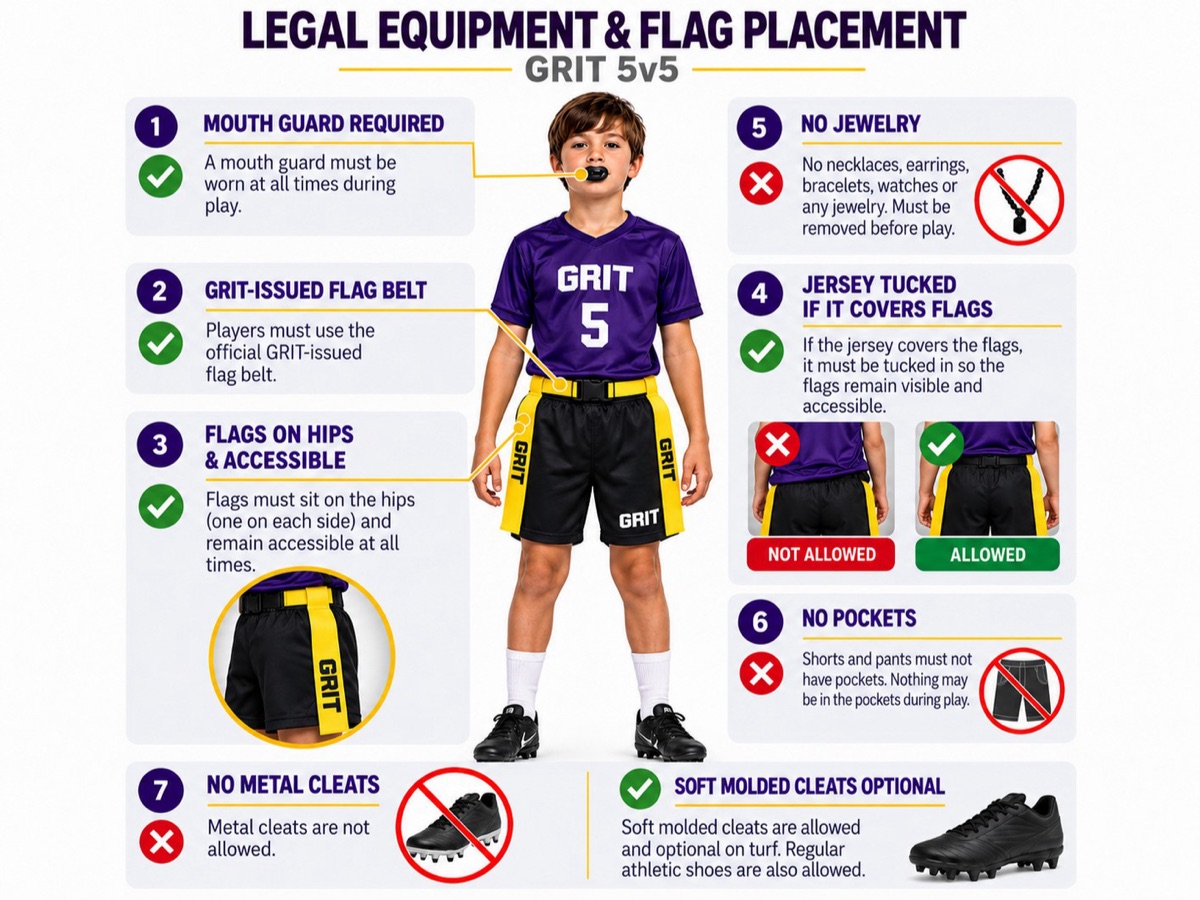
- A mouth guard is required whenever a player is on the field.
- Players must use a GRIT-issued or GRIT-approved flag belt. Standard GRIT play uses two flags, positioned at the hips, one on each side.
- Girls K–2nd and Boys K–1st use three flags: one on each hip and one centered at the back.
- Flags must remain fully visible and accessible. A jersey must be tucked if it hangs below the belt line or interferes with access to a flag.
- Shorts or pants with pockets are not permitted.
- Jewelry is not permitted unless GRIT specifically approves an exception.
- Shoes are required. Cleats are permitted when the facility allows them, but exposed metal cleats are never permitted.
- Gloves, elbow pads, knee pads, and properly secured soft protective headgear may be worn if safe and non-metallic.
- Braces or equipment with exposed metal are not permitted.
4. Game timing
- Games use two 20-minute running-clock halves.
- Halftime is 2 minutes unless GRIT announces otherwise.
- The running clock stops for team timeouts, injuries, halftime, and at the referee’s discretion.
- Once the ball is ready for play, the offense has 40 seconds to snap the ball.
- Each team receives one 60-second timeout per half. Timeouts do not carry over.
5. Scoring
| Scoring Play | Points |
|---|---|
| Touchdown | 6 |
| 1-point try | 1 — from 5 yd; pass only |
| 2-point try | 2 — from 10 yd; run or pass |
| Safety | 2 |
| Interception return on try/OT | 2 |
- After a touchdown, the offense must declare whether it will attempt 1 or 2 points.
- Changing the declared try requires a timeout before the play clock expires. A declaration cannot be changed after a penalty.
6. Mercy rule
- A 35-point advantage ends the game for official scoring purposes.
- For the youngest divisions, the referee and GRIT staff may allow play to continue for developmental purposes if both Head Coaches agree. The official score remains final when the 35-point threshold is reached.
7. Overtime — regular season
- If regulation ends tied, GRIT may play up to two overtime rounds.
First overtime
- Each team receives one play and chooses either 1 point from the 5-yard line or 2 points from the 10-yard line.
Second overtime
- If still tied, each team receives one 2-point attempt from the 10-yard line.
- If still tied after the second overtime, the game ends in a tie.
- No timeouts are permitted in overtime.
- Interceptions are returnable and are worth 2 points in overtime.
8. Live ball / dead ball
- The ball becomes live at the snap and remains live until an official whistles the play dead.
- Substitutions may be made during any dead-ball period.
The play is dead when:
- the ball hits the ground;
- the ball carrier’s flag is pulled or falls out;
- the ball carrier steps out of bounds;
- a touchdown, try, or safety is scored;
- the ball carrier’s knee, shin, leg, forearm, or arm contacts the ground;
- a receiver gains possession with one or no flags attached;
- the 7-second pass clock expires;
- an official sounds an inadvertent whistle; or
- the ball carrier illegally dives, leaps, or hurdles to advance the ball.
- Fumbles are not live. When a loose ball contacts the ground, the play is dead at that spot.
9. Running
- The ball is spotted where the ball is when the flag is pulled.
- The quarterback may not directly run across the line of scrimmage after receiving the snap.
- Direct handoffs, pitches, and laterals are permitted behind the line of scrimmage.
- The center may not receive the first handoff, pitch, or lateral from the quarterback (“center sneak”).
- After a legal handoff, pitch, or backward lateral, the 7-second pass clock is removed and all defenders may cross the line of scrimmage.
- Running plays are prohibited in no-run zones, except in the youngest divisions where no-run zones are not used.
- Ball carriers may not hurdle or leap defenders to advance the ball.
- A player may leave the ground for a spin, jump cut, pass, catch, or clearly to avoid a collision, provided illegal contact is not initiated.
10. Passing & receiving
- Only one forward pass is permitted per play, and it must be released from behind the line of scrimmage.
- A forward pass must cross the line of scrimmage unless touched by a defender.
- There is no intentional-grounding penalty. The passer may throw the ball beyond the line of scrimmage to avoid a sack.
- Shovel passes are legal when thrown forward from behind the line of scrimmage and received beyond the line of scrimmage.
- The quarterback has 7 seconds to release a forward pass. If the pass is not released in time, the play is dead, the down counts, and the ball returns to the line of scrimmage.
- All players are eligible receivers, including the quarterback after a legal handoff, pitch, or lateral.
- A catch is complete when the receiver controls the ball and at least one foot, or another body part other than a hand, contacts the field in bounds first.
- Simultaneous possession is awarded to the offense.
- Interceptions are returnable.
11. Rushing the passer
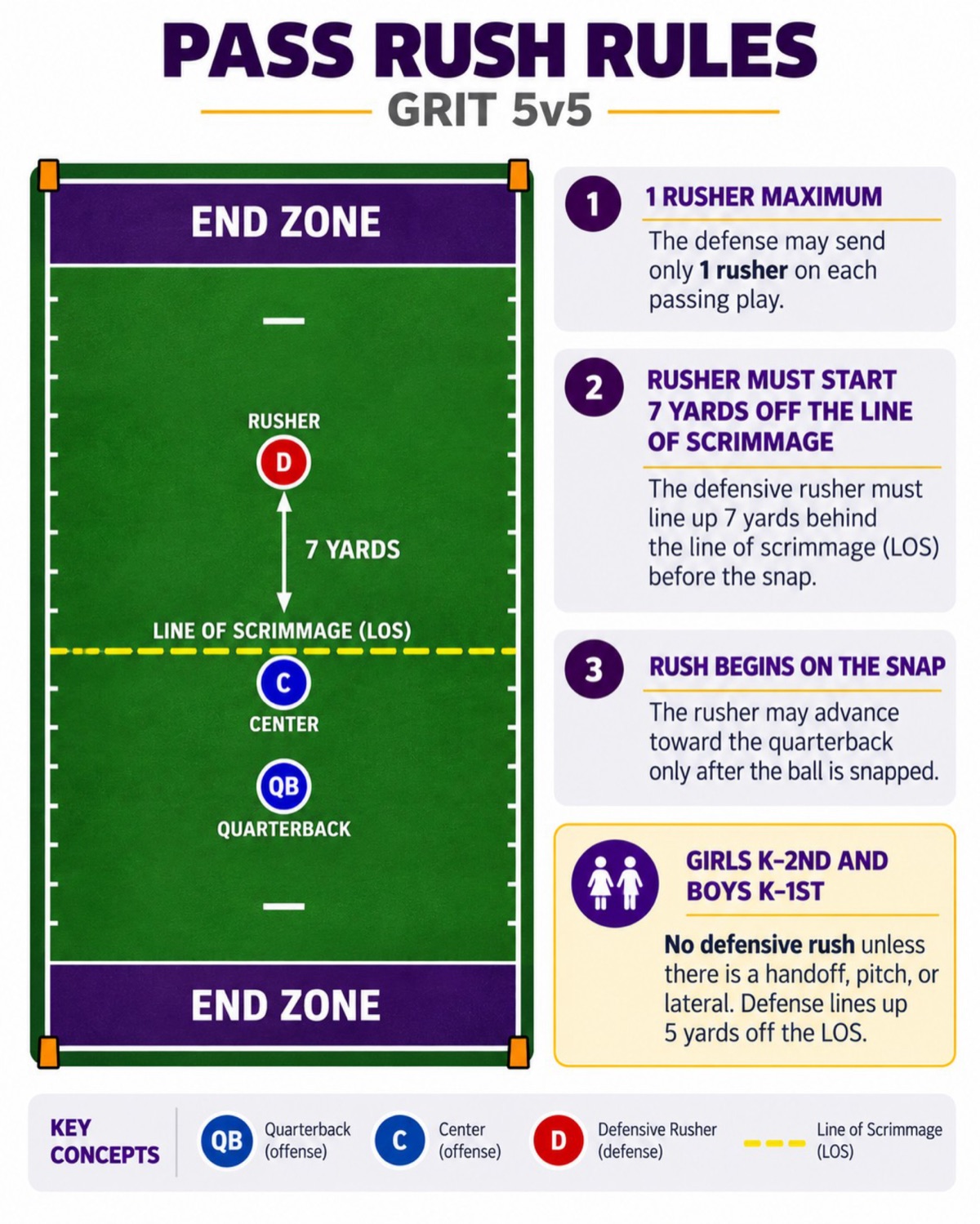
GRIT ADOPTION GRIT allows one designated rusher in all divisions except the youngest divisions.
- The designated rusher must begin at least 7 yards from the line of scrimmage.
- The rusher must identify themselves before the snap and must rush immediately after the snap. Delayed rushing is not permitted.
- Teams are not required to rush the quarterback while the 7-second pass clock is in effect.
- After a legal handoff, pitch, or backward lateral, all defenders may cross the line of scrimmage.
- The offense may not impede the rusher’s direct pre-snap path to the quarterback. A moving offensive player is responsible for avoiding that path.
- A rusher may attempt to block a pass but may not make illegal contact with the passer.
YOUNGEST-DIVISION EXCEPTION Defenders may not rush the passer unless a legal handoff, pitch, or lateral occurs in the backfield.
12. Flag pulling
- A legal flag pull occurs only when the ball carrier has possession.
- Defenders may dive to pull a flag but may not tackle, hold, or run through the ball carrier.
- Stripping or attempting to pull the football from the ball carrier is illegal.
- If a ball carrier’s flag falls off during the play, the runner is down immediately.
- A player who gains possession while wearing one or no flags is down at the spot of possession.
- A defender may not intentionally pull the flag of a player who does not have the ball.
- Flag guarding is illegal. This includes stiff-arming, dropping the head, hand, ball, arm, or shoulder to block access to the flag, or intentionally covering flags with the jersey.
13. Formations, motion & contact
- The offense must have at least the center on the line of scrimmage. The quarterback must be off the line of scrimmage.
- The center snaps the ball in a rapid, continuous motion between the legs to a player in the backfield.
- Only one offensive player may be in motion at the snap. Motion must be parallel to or backward from the line of scrimmage.
- Players may shift before the snap but must reset for at least one second before the snap.
No blocking or screening
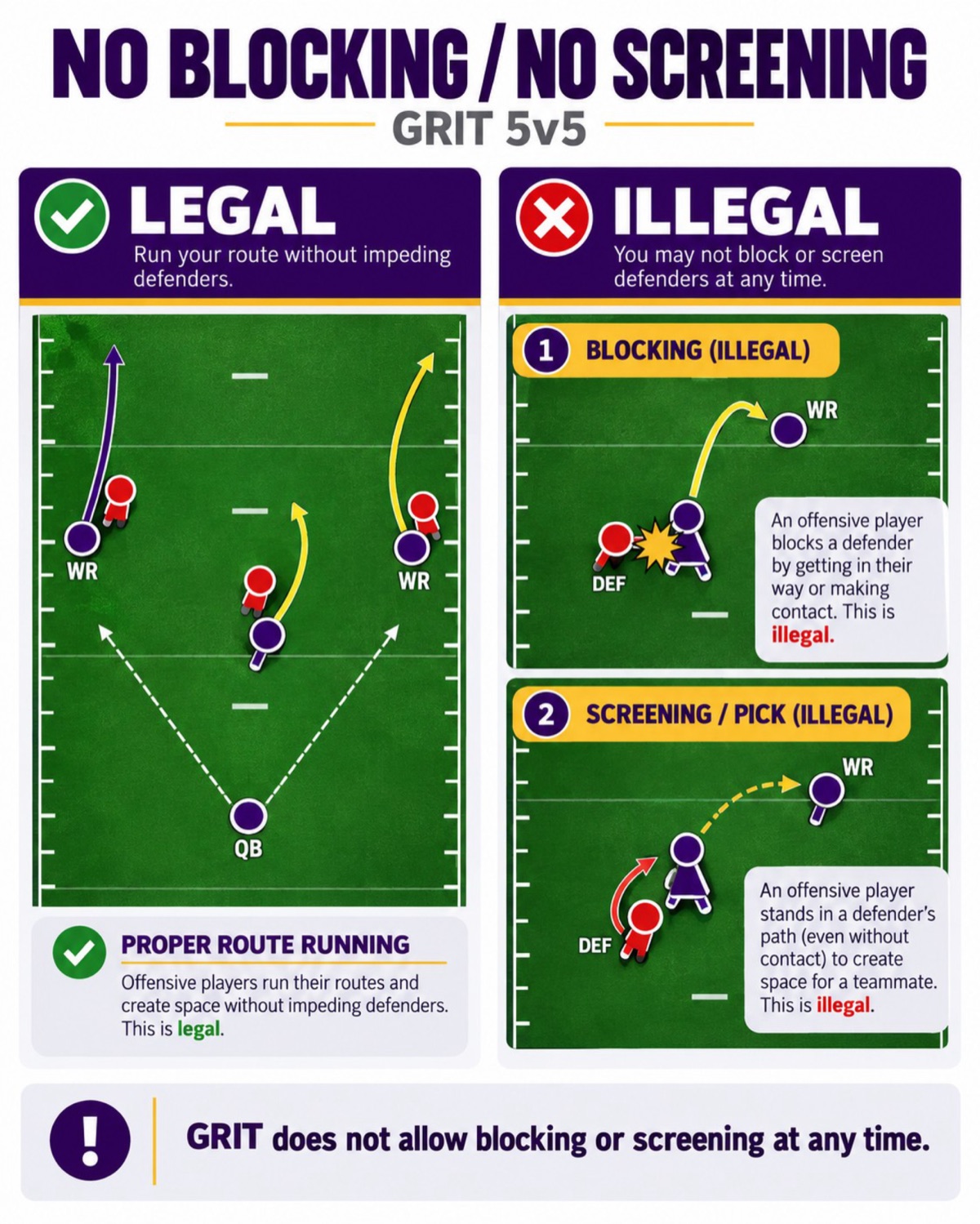
- Blocking and screening are prohibited, including “no-touch” screening.
- An offensive player may not intentionally position or move their body to obstruct a defender’s path to the ball carrier, even without contact.
- Offensive players near the ball carrier must stop advancing with the runner after the ball crosses the line of scrimmage.
- Ball carriers must make an effort to avoid defenders who have established position. Charging is illegal.
14. Coaches
- Coaches must follow the GRIT Code of Conduct and are responsible for maintaining an orderly team area.
- Only the Head Coach or team captain may ask an official for a rule clarification, and questions must be respectful and made at an appropriate time.
- Coaches remain on the sideline during live play except for the youngest-division exception below.
15. Youngest-division rules
APPLIES TO Girls K–2nd and Boys K–1st.
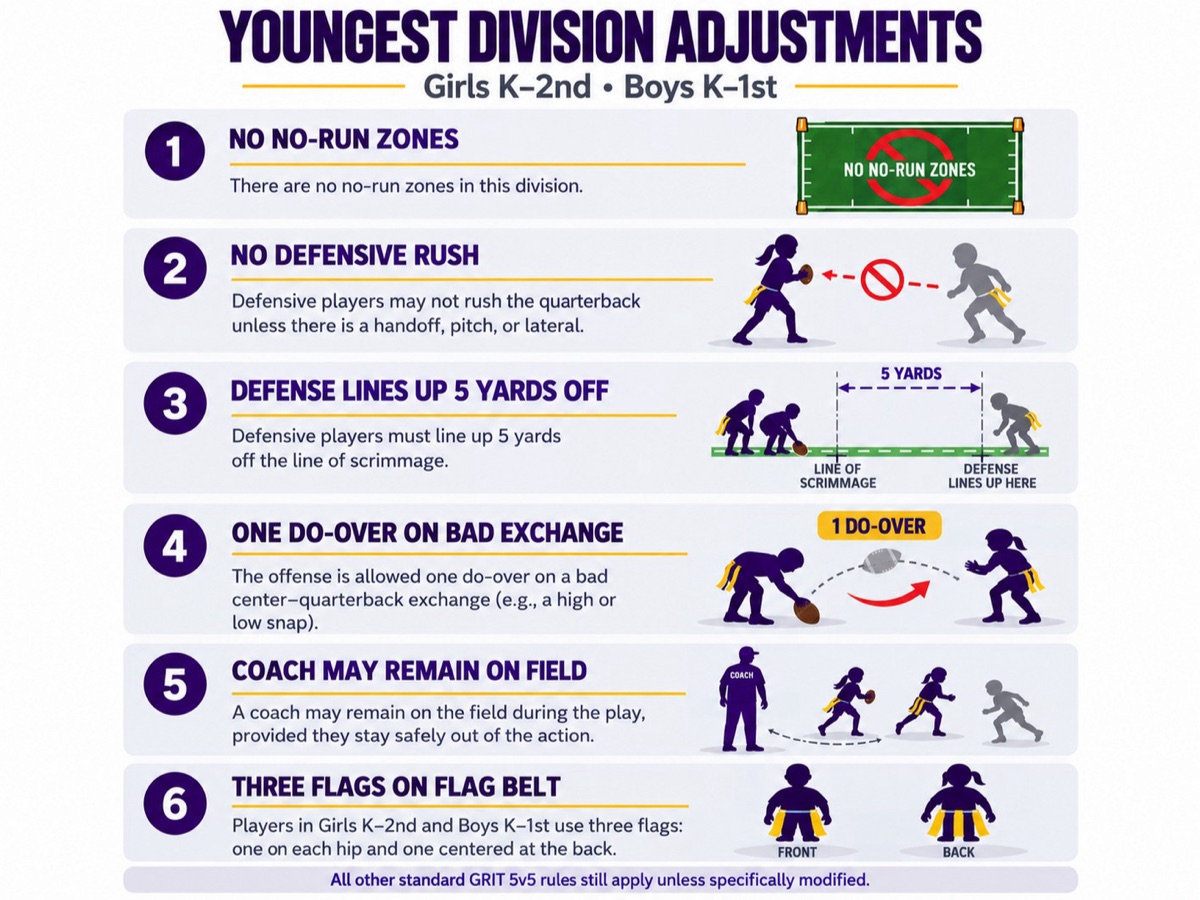
- No-run zones are eliminated. Teams may run anywhere on the field.
- Defenders may not rush the passer unless there is a legal handoff, pitch, or lateral in the backfield.
- Defenders must line up at least 5 yards from the line of scrimmage before the snap. If the ball is on or inside the 5-yard line, the distance is reduced to 3 yards.
- If the initial center-to-quarterback exchange touches the ground, the offense receives one do-over with no loss of down. A second consecutive bad exchange consumes the down.
- One coach from each team may remain on the field before and during the play to assist players. The coach must remain at a safe distance and may not interfere with play.
- Players use three flags: one on each hip and one centered at the back.
- The 7-second pass clock remains in effect.
- The 35-point mercy rule applies for official scoring, but play may continue for developmental purposes at the discretion of the referee and GRIT staff if both Head Coaches agree.
16. Sportsmanship & safety
- Intentional tackling, elbowing, cheap shots, fighting, retaliation, threats, and deliberate unsafe contact are prohibited.
- Officials may eject a player or coach for serious or repeated unsportsmanlike conduct.
- Players, coaches, and spectators are also subject to the GRIT Code of Conduct and league-level discipline.
17. Penalties
Officials administer all penalties. Penalties are generally enforced from the line of scrimmage unless listed as spot fouls. When penalty yardage exceeds half the distance to the goal, enforcement is half the distance to the goal.
A “loss of down” means the down on which the foul occurred is consumed; the offense does not replay that down.
Defensive spot fouls
| Foul | Enforcement |
|---|---|
| Pass interference | Automatic 1st down |
| Holding / illegal contact | +5 yd, automatic 1st |
| Stripping | +5 yd, automatic 1st |
Offensive spot fouls
| Foul | Enforcement |
|---|---|
| Screening / blocking | -5 yd, loss of down |
| Charging | -5 yd, loss of down |
| Flag guarding | -5 yd, loss of down |
| Holding / illegal contact | -5 yd, loss of down |
Other defensive penalties
| Foul | Enforcement |
|---|---|
| Unnecessary roughness | +10 yd, automatic 1st |
| Unsportsmanlike conduct | +10 yd, automatic 1st |
| Offside / illegal substitution | +5 yd from LOS, automatic 1st |
| Illegal rush | +5 yd from LOS, automatic 1st |
| Illegal flag pull | +5 yd from LOS, automatic 1st |
| Roughing passer | +5 yd from LOS, automatic 1st |
| Taunting | +10 yd from LOS, automatic 1st |
Other offensive penalties
| Foul | Enforcement |
|---|---|
| Unnecessary roughness | -10 yd, loss of down |
| Unsportsmanlike conduct | -10 yd, loss of down |
| Offside / false start / illegal substitution | -5 yd from LOS, loss of down |
| Illegal forward pass | -5 yd from LOS, loss of down |
| Offensive pass interference | -5 yd from LOS, loss of down |
| Illegal motion | -5 yd from LOS, loss of down |
| Delay of game | -5 yd from LOS, loss of down |
| Impeding the rusher | -5 yd from LOS, loss of down |
| Illegal procedure | -5 yd from LOS, loss of down |
| Taunting | -10 yd from LOS, loss of down |
- Games and halves may not end on a defensive penalty unless the offense declines it.
- Live-ball penalties are enforced before dead-ball penalties.
- Spot fouls in the end zone: defensive foul — ball at the 1-yard line and first down; offensive foul — safety.
18. Rule administration
- Officials determine incidental contact arising from normal play.
- A team may use a timeout to question a rule interpretation. If the ruling is corrected, the timeout is restored; judgment calls are not subject to re-officiating.
- GRIT may issue clarifications or league adoptions when needed for safety, facility conditions, competition format, or operations. Current GRIT adoptions supersede conflicting language in earlier versions.
Questions: info@gritflag.com or message GRIT in the app.
Stay in the loop
Email updates, league news, registration reminders, and game-day info. Unsubscribe anytime.